
The Janitor Problem
Chapter 1 of The Orbital Janitor

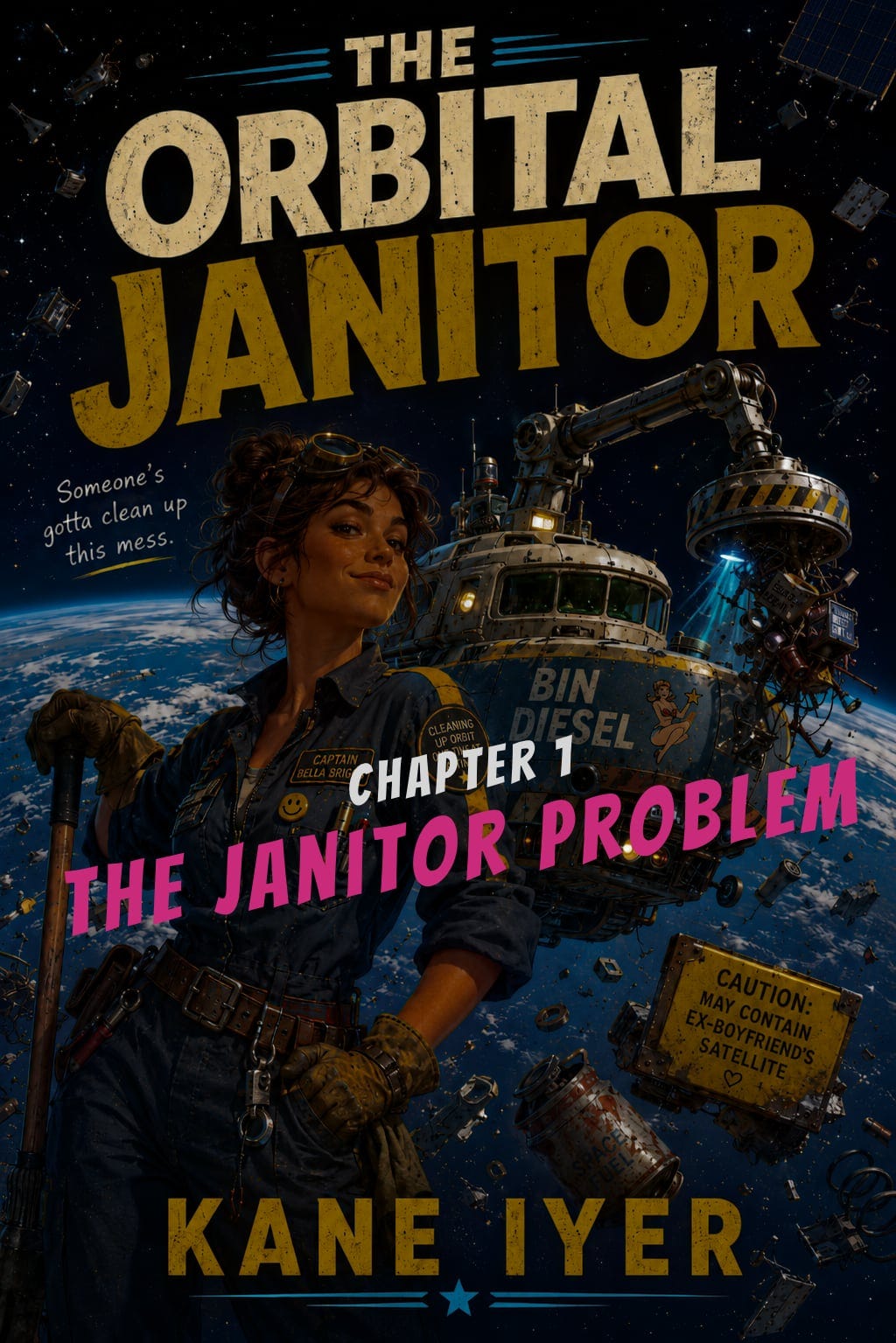
I wake up to an impact alarm and the deeply comforting realization that I am not dead. This puts me ahead of schedule for the day.
“Okay,” I say to nobody, because nobody else is stupid enough to be up here on a freelance debris tug. “Let’s not panic.”
The console disagrees. It is panicking in several colors. Relative velocity alert. Hull integrity warning. Attitude drift. And my personal favorite: Untracked object cluster.
Untracked is space for “we have no idea what just hit you, but statistically you’re about to have a worse day.”
I grab the nearest handhold and pull myself toward the forward display. Outside, Earth is doing its usual majestic blue-marble thing, completely unconcerned with my current situation, which I find rude.
“Status,” I tell the ship.
The ship, whose name is Municipal Asset Recovery Unit 12—because no one lets contractors name anything and because joy is apparently taxable—responds with a flat synthetic voice. I call her Bin Diesel, which is a terrible name, but unlike the official one, it has a personality.
“Multiple micro-impacts detected. Source: debris field. Estimated density increasing.”
“Of course it is,” I say. “Why would it decrease? That would be convenient.”
I bring up the radar overlay. It takes a second to resolve, then fills with dots. Not a lot of dots. Not yet.
That’s worse. ‘Cause I know what comes next.
“Okay,” I say, cracking my knuckles. “Let’s do some math before we die.”
I pull the last known debris maps. Cross-reference with my current orbit: 640 kilometers, slight inclination drift which means the station-keeping thrusters have been sticking again—don’t get me started—and—
Nothing matches.
“This is new,” I say.
New is bad. New means no one has modeled it, no one has simulated it, and no one has written a reassuring memo about it.
The density ticks up again. The dots multiply. Not randomly—there’s structure. A gradient. I rotate the view.
“Oh,” I say.
Oh is the worst thing you can say in space.
Why? ‘Cause what I’m looking at is not just debris.
It’s a cascade. C-A-S-C-A-D-E!
Somewhere, something big broke. Then the pieces hit other things. Those pieces hit more things. Each collision makes more debris, which makes more collisions.
It’s not a field. It’s a chain reaction.
“Right,” I say. “Kessler syndrome. Fantastic. Love that for me.”
I check relative velocities. Average closing speed: 11 kilometers per second—or nearly 7 miles per second for imperial goons.
For context, that is “if you get hit, you become a fine mist with opinions.”
“Options,” I say.
The ship helpfully provides none.
I’ve got maneuvering thrusters, a half-full propellant tank, and a job description that technically reads: collection and disposal of orbital debris.
“Well,” I say. “This counts. Fuck me.”
Another impact rattles the hull. Smaller this time. I check the pressure.
Still holding.
“Good ship,” I say, patting the panel. “Please continue being airtight. It’s your best feature.”
I zoom out again, watching the cascade propagate along orbital paths like cracks in glass. And that’s when something clicks.
The pattern isn’t random. It’s following traffic lanes.
Satellites cluster in certain orbits—communications bands, observation shells, all the crowded, profitable real estate. The cascade is eating those first.
Which means—
“Which means there are gaps,” I say.
Less crowded orbits. Lower debris density. Temporary safe zones.
Temporary being the key word, because this thing is spreading.
Fast.
I plot a transfer. It’s ugly. High delta-v, tight timing, and if I get it wrong I’ll slam directly into a cloud of shrapnel moving at orbital speeds.
“No pressure,” I mutter.
The console chimes.
“Warning: maneuver will exceed recommended fuel reserves.”
“Yeah,” I say. “Well, the recommended alternative is exploding, so we’re going to live dangerously.”
I queue the burn, then pause. Because here’s the problem.
Even if I get out... this doesn’t stop, rather this gets worse.
Every collision feeds the next. Every satellite up here becomes ammunition.
We don’t just lose my ship… we lose orbit.
No more stations. No more satellites. No more anything above the atmosphere that isn’t immediately shredded.
I stare at the spreading web of debris, and a thought occurs to me that is, in technical terms, extremely stupid.
“...What if I clean it up?” I say.
Bin Diesel does not respond, which is fair.
Because here’s the thing about debris collection.
We don’t prevent collisions. We pick up what’s left after.
But what if—
What if you get ahead of it?
Target high-risk fragments. Nudge them. Change trajectories just enough that they miss the next impact.
Break the chain reaction! Not just clean the mess, but stop it from becoming one.
I look at my tiny tug, my underpowered thrusters and my definitely-not-designed-for-this grappling rig.
Then I look at the math: Velocity vectors. Collision probabilities. Time to intercept.
It’s impossible.
Which is encouraging, because everything up here is impossible right up until someone does it anyway.
“Okay,” I say, strapping in. “New plan. We are no longer janitors.”
Another impact pings off the hull.
“We are now... preventative janitors.”
I bring the thrusters online.
“Let’s go stop a cascade.”
What a fun start!! Looking forward to more!!
Really good, Kane. Sucked me right in.
I was planning on reading it later, but by the time I scanned the second sentence, I was reading it NOW.